Selecting the right aperture radius requires a balance. The aperture should be large enough to capture most of the star’s light but small enough to exclude unnecessary background noise and light from neighboring stars. The goal is to maximize the measurement’s signal-to-noise ratio, or SNR.
A photometric aperture consists of a circular region centered on the star and a surrounding sky annulus used to measure the background.
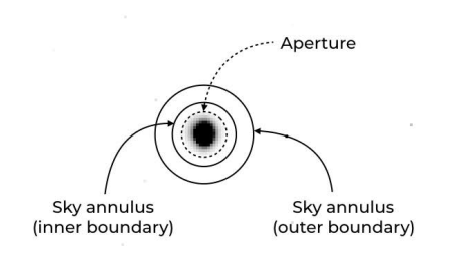
Anatomy of a photometric aperture. Source: Soka University of America.
1. The FWHM Rule of Thumb
For most applications, the quickest method is to base the aperture radius on the Full Width at Half Maximum, or FWHM, of the stars in the image.
- Measure the FWHM of several typical, unsaturated stars in the image.
- Set the aperture radius to approximately 1.5 to 2.0 times the FWHM.
This range usually captures most of the stellar flux while limiting the amount of background noise included in the measurement.
2. Curve-of-Growth Analysis
For higher-precision measurements or images with unusual point-spread functions, you can construct a curve of growth.
- Measure the target’s flux through a series of concentric apertures with increasing radii.
- Plot the total enclosed signal against the aperture radius.
The measured signal rises steeply at first and then begins to level off as the aperture captures the faint outer wings of the star’s profile. Choose an aperture near the point where the curve begins to flatten, before the accumulation of background noise begins to degrade the measurement.
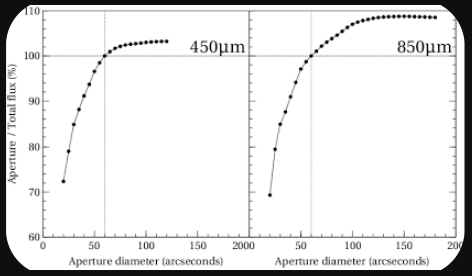
A standard curve of growth. Source: Starlink.
3. Maximizing the Signal-to-Noise Ratio
As the aperture radius increases, the amount of light collected from the star grows more slowly. Background noise, readout noise, and dark-current noise continue to increase as more pixels are included.
Because the area of a circular aperture is proportional to the square of its radius, the background noise grows approximately in proportion to the aperture radius.
If the aperture is too small:
- some of the star’s flux is excluded,
- small centering errors have a greater effect, and
- variations in atmospheric seeing can change the fraction of light inside the aperture.
If the aperture is too large:
- additional sky pixels contribute little or no starlight,
- those pixels add noise to the measurement, and
- the resulting SNR decreases.
Many photometry programs can calculate the SNR for several aperture radii. For a particular image, the radius that produces the highest SNR is generally the best choice.
The Sky Annulus
After selecting the aperture radius, define a sky annulus around the star. The annulus is used to measure the local sky background so that it can be subtracted from the stellar signal.
Inner radius
Place the inner boundary far enough from the star that the annulus does not include the faint outer wings of its profile. A typical starting point is approximately four to five times the aperture radius or FWHM.
Outer radius
Make the outer boundary large enough to include enough sky pixels for a reliable background measurement. A typical starting point is approximately six to seven times the aperture radius.
The annulus should not contain neighboring stars, cosmic-ray hits, image defects, or strong background gradients.
Keep the Aperture Consistent
Once you select an aperture radius, use the same radius for the target and comparison stars within the image.
A star’s profile extends beyond any finite aperture, so every aperture captures only a fraction of its total light. Using the same aperture for every star ensures that approximately the same fraction is measured, preserving the accuracy of relative photometry.