This document assumes you have saved the light curve generated with the Large Ensemble Photometry application as a CSV file, as described in Part 3.
In this example, we determine the period of the variable star SZ Lyn using the VSTAR application.
Install VSTAR
Download and install VSTAR from:
Prepare the CSV File
Open the CSV file generated in Part 2 and delete all columns except:
JDTarget Mag
Save the file again as a CSV containing only these two columns.
Load the Data into VSTAR
Load the CSV file into VSTAR.
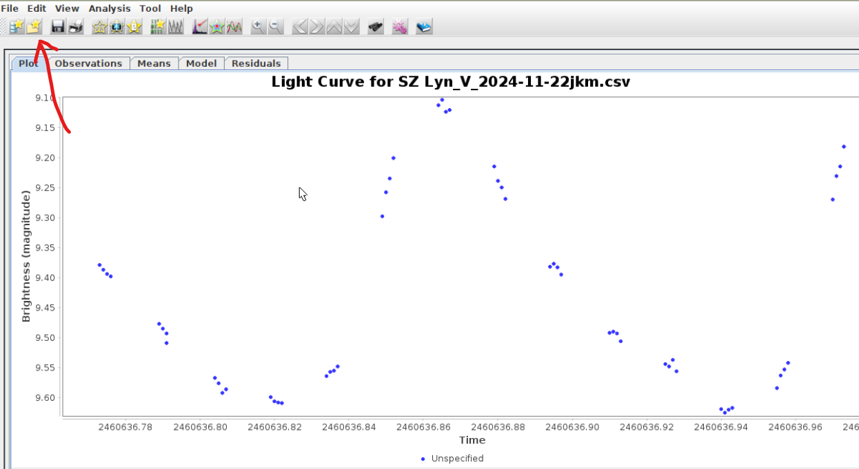
Perform a Fourier Analysis
- Click:
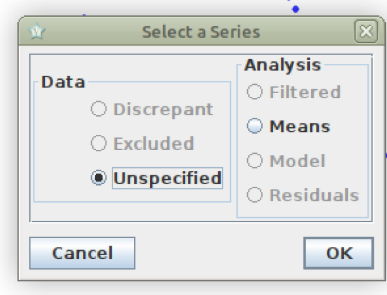
Analysis → DC DFT standard scan
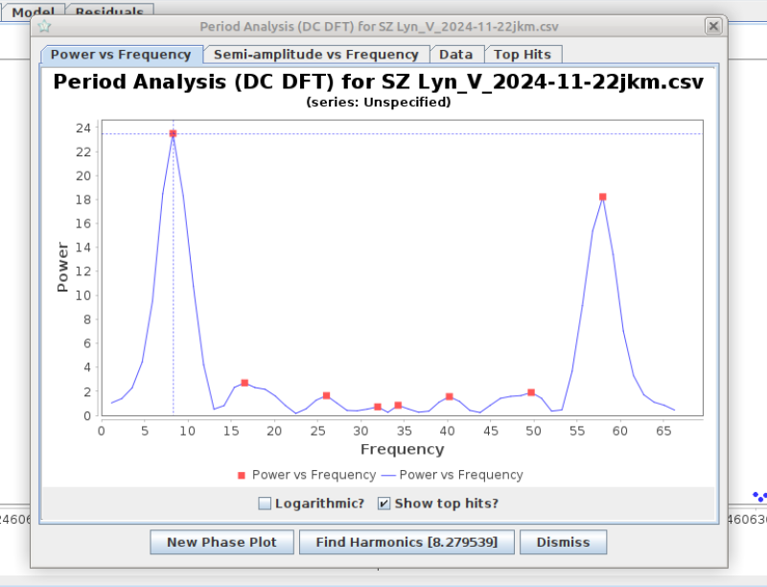
This produces a Data Compensated Discrete Fourier Transform (DC DFT) of the light curve.
Because the example series does not have a name, it is labeled as unspecified.
Determine the Candidate Frequency
Click on the highest (red) data point in the power spectrum to obtain the candidate frequency.
In this example, the candidate frequency is:
8.28 cycles/day
The corresponding period is:
Period = 1 day / 8.28
       = 0.1208 days
       = 2.899 hours
Conclusion
The Fourier analysis performed by VSTAR yields a candidate period of:
Period ≈ 2.899 hours
This value is in excellent agreement with the period determined previously using LEPhot, confirming that SZ Lyn has a period of approximately 2.89 hours.